

A Contentment Practice
for wading through the muck.

A client asked me recently to talk about “being patient in the waiting.” She didn’t elaborate, but I have a hunch her larger question is this:
“I want to be done with this struggle, to finally get to the other side, but I’m not there yet. How do I stay hopeful and patient as I slog through the sucky tar pit in the middle?”
It’s a great question, and I think my answer is applicable to Thanksgiving week too, which if we’re honest, is frazzling and difficult, lonely even, for many people.
I myself always want the quickest route through difficulty or suffering; seeking advice for escaping it, or cultivating more patience through it. That’s normal I suppose, but I think I’m asking the wrong questions.
The right question is not: “How do I survive through this,” but rather, “how do I find contentment during it?”
Admittedly, that’s a much harder question.

On Contentment
The Apostle Paul famously said, I have learned to be content whatever the circumstances - whether abased or abounding. What a marvel, considering he wrote that from a Roman prison, probably while standing in ankle-deep sewage.
So how do we do that? Not just endure things, but be content through them?
For Paul, the answer is he can do all things through Christ who strengthens him, but please note, Paul said he LEARNED to be content, relying on a strength not his own.
Sounds like a skill and then a practice.

But How?
Sam and I just spent three weeks at home in Florida.
It was glorious using my own washer and dryer, leaving dishes in my very own sink. Sitting on my own porch drinking coffee.
On the porch one morning, listening to the birds, I felt something new land on me and settle like glitter. It was the sense that everything - and I mean everything - is and will be all right. The correct word for it is contentment, and it had been a long time since I’d felt it.
Then because I’m me, I immediately tried to reverse engineer it. You know, so I could get it back later, which immediately ruined it because that’s not how contentment works.
Now we’re back out west.
Sam, the dogs and I drove 1700 hundred miles to get here, which is frazzling. It’s also Thanksgiving week where, as a nation, we mash ourselves into airports and freeways then collide with our families, trying to keep the word fascism out of dinner conversations. Also frazzling.
It’s in these frayed nerves and tight chests that a contentment practice is powerful. Instead of wishing for the hard parts to be over faster, we LEARN to accept them - waiting well by dropping in and breathing through.

Present Moment Awareness
Breath is the portal to present moment awareness and sometimes when the tarpits are extra deep and sticky, breathing is all we can do.
Now, don’t roll your eyes and say, “Yah, yah breathwork I know that, thanks,” because as Steven Covey says, “to know and not to do is not to know” and I can see from here how shallow your breath is.
Shallow breath is a reflex that makes everything worse, but we’re so used to it we forget that’s not even the design of our lungs. Shallow breath is a sure sign we’re time traveling to a future we think we can control, or to a past we regret.
But when things get tense at dinner or your hope is failing, you can always stop and breathe. There is only now anyway, and the door into that awareness is your breath.
So stop here and inhale for four counts.
Hold it for five counts.
Release it for eight counts.
Do it again. Inhale for four. Hold it for five. Release it for eight. Now that you’ve stopped to enjoy life’s most incredible miracle, which we take for granted every day, here’s the big question:
What is actually wrong right now, in this precise moment?
Sure, there might be things. You might be in a Roman prison, but when you stop thinking what tomorrow will be like in prison, or when you’re going to get out, or how the guards really ought to treat you better, you may notice more calm spaciousness.
This is contentment practice.
Darling, I say this with love, you can stop and breathe right now. You don’t have to argue or plot. You can tune out, drop in and watch your breath instead. You don’t have to wait until circumstances improve; breathing like this - even if challenging - will likely improve your handling of all circumstances.
And what if the God who loves you is waiting for you to quit rushing through the pain trying to get to the other side? What if he’s ready to help you endure what you must and learn to be content within it, like Paul said?
Time traveling doesn’t allow for that. Nor does trying to convince people who won’t be convinced. Only breathing and asking for strength to handle what must be handled does.
Four. Five. Eight.
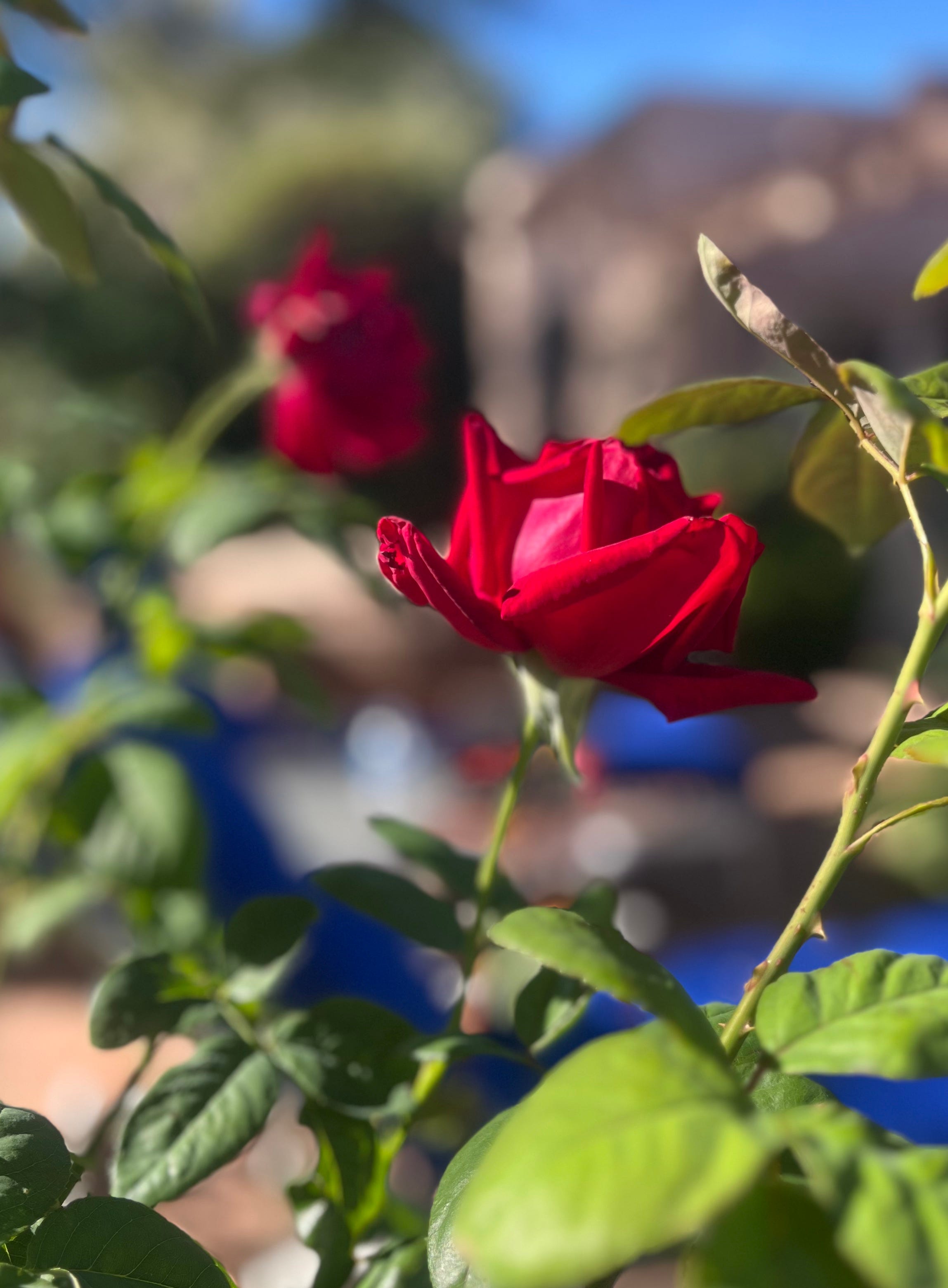
My parents are excellent gardeners.
I am sitting on their patio by an old red rose with a thick stump of a stem, the size of my wrist. Its five red velvet blooms dance a little in the breeze releasing a fragrance so beautiful it nearly breaks your heart. I keep breathing deep, trying to catch it.
Can that be an accident, given the topic at hand?
God smiles.
So the answer to my client’s question, I think, isn’t to be more patient in order to survive the difficulty, though that’s a good idea too, but rather to practice contentment within the difficulty, allowing things to unfold as they will.
That’s harder, but sometimes there’s glitter.
To put a fine point on it, Father Mike Schmitz, a priest I listen to, said this in a homily called God is Right in Front of Us.
We trust that even when all is lost...God will be there. Because Christian hope is not thinking that all will be well because I’ll get my way. Christian hope is trusting all will be well even when I don’t.
I hope I remember this when I’m in despair. That in rose gardens or tarpits, God is ever-present and helping. I just have to drop in long enough to notice.
Happy Thanksgiving!